About the Image(s)
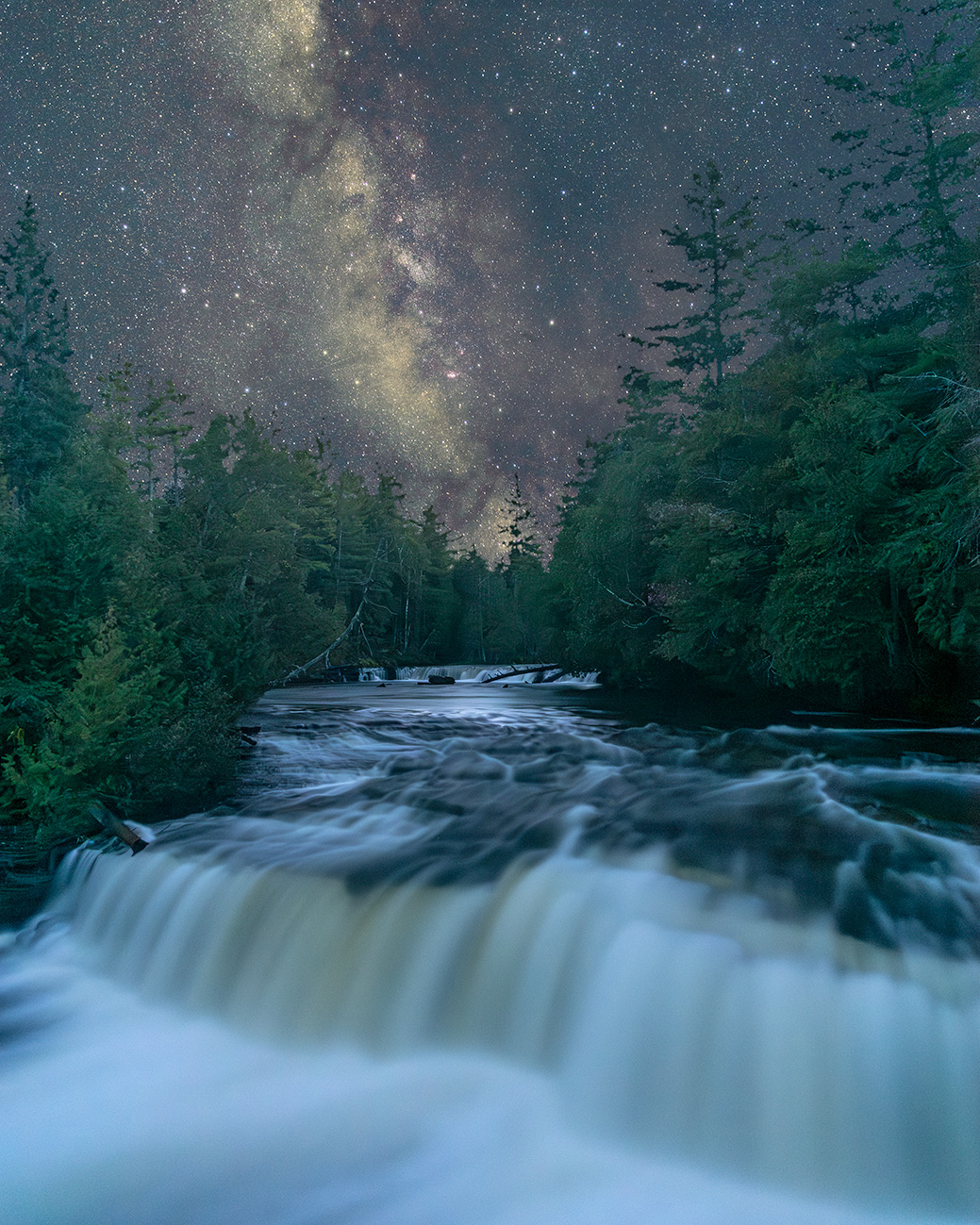
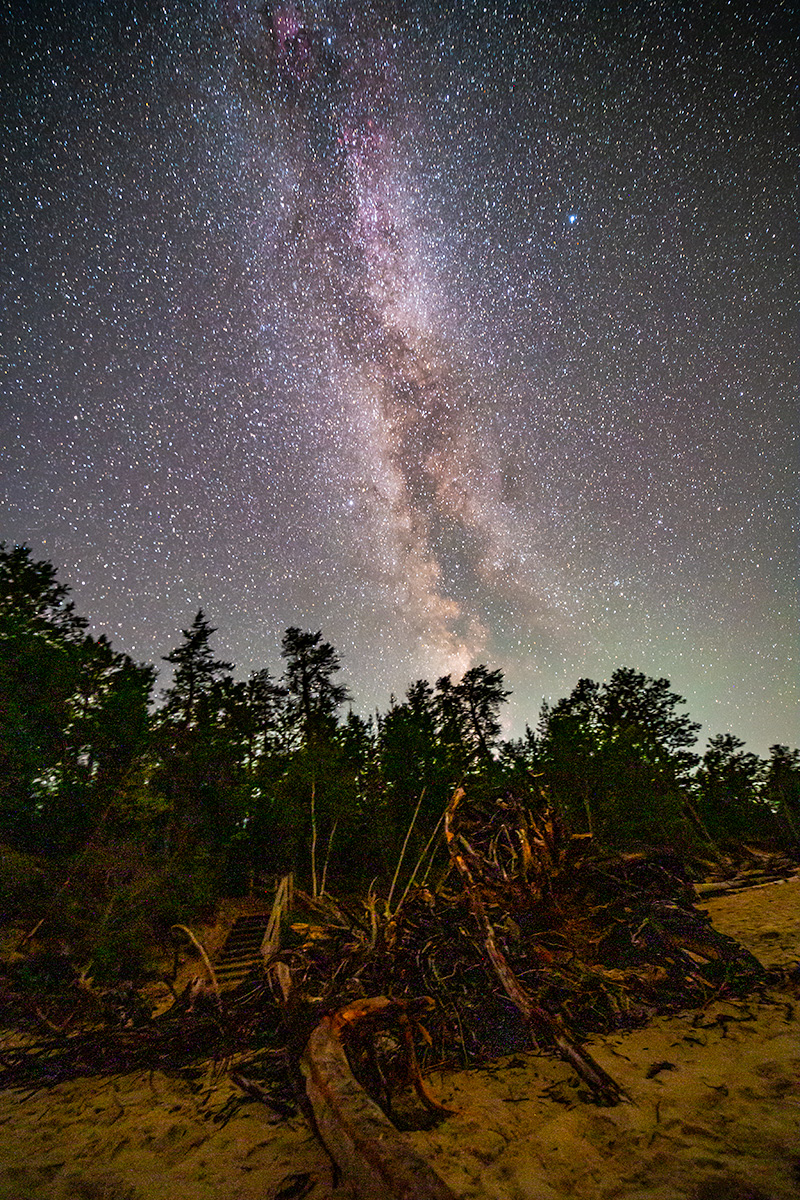
The final image is a blue hour blend of Tahquamenon Falls in the upper peninsula of Michigan. My daughter in law and I went up 3 weeks ago with hopes of getting the milky way at the upper falls as I had purchased a permit for the summer to go out at night and we had not been there. With the milky way season coming to an end we hoped to have clear skies and good milky way position. The milky way was not in the best position for an upper falls shot but when I pulled it up on PhotoPills I was excited to see the milky way was rising in a perfect spot over the lower falls.
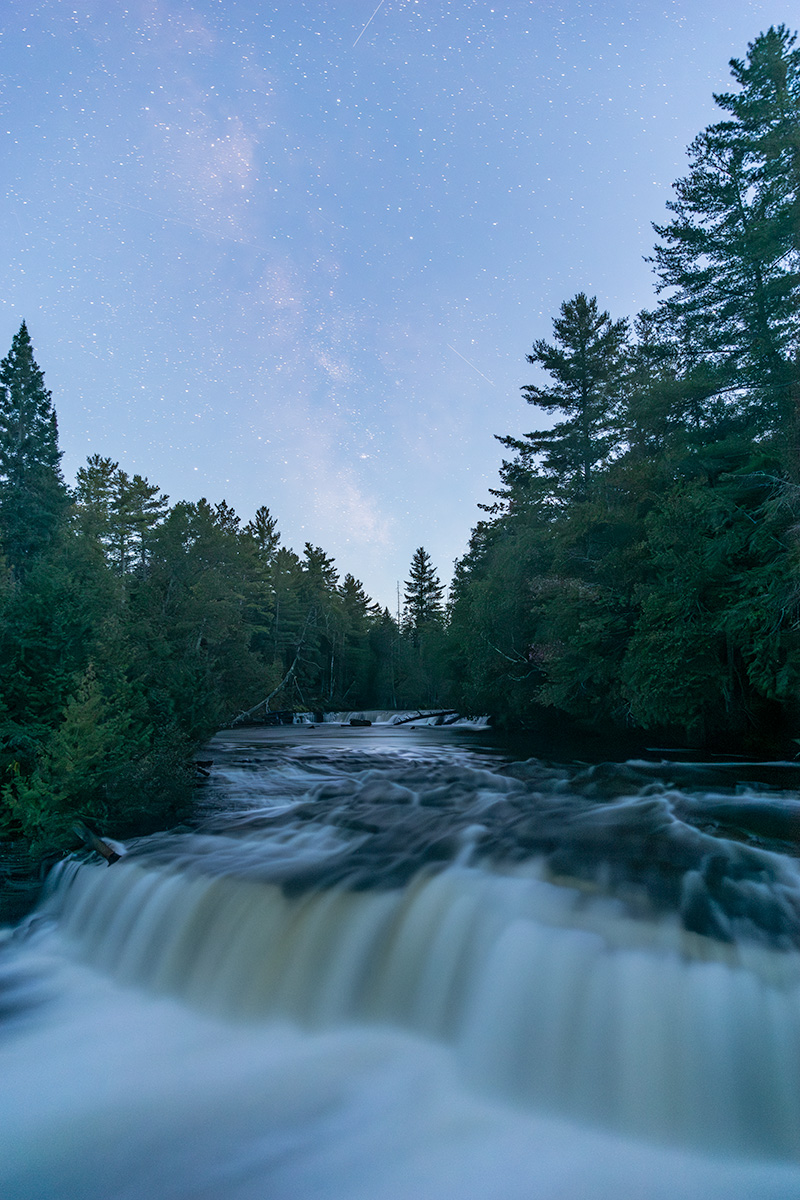
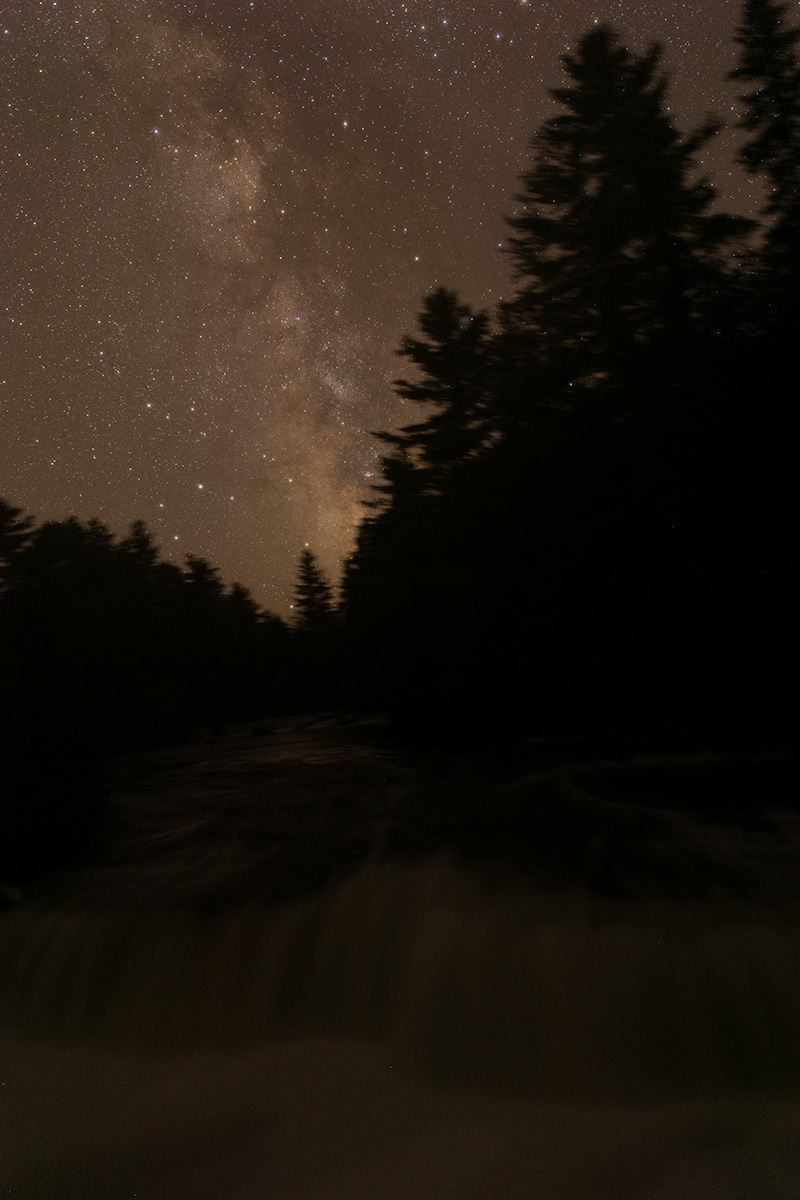
I set my tripod up and took my foreground shot at the blue hour and then covered my camera with my raincoat while I waited for the milky way to rise and present in the spot I was waiting for. The foreground was shot at ISO 2500, f3.5, 24mm, at 25 sec. The sky was shot using a sky tracker and ISO 800, kelvin 5800, 24mm, f 2.8 and 2 1/2 minute exposure.
Andres Valdespino
Cindy, this is a beautiful photo on so many levels. First finding a location where the milky way falls into the lowest point of the trees is perfect. Taking two, or probably more, shots at the same location so much time apart. The long exposure for the sky is necessary. But using a long exposure for the foreground to get that effect on the water really elevates the photo. The astrophotography in this group has inspired me to start thinking about it, especially as we move into winter with longer nights and, hopefully, clearer skies. Well done. Posted: 10/08/2026 02:06:52
Cindy Bilinsky
Andres I am glad the milky way images have inspired you to go out and capture the night sky. I would like to share a few things that will help you as you go out and see what you can capture. the milky way core is visible February through October so we are winding down for this year on the core visibility. You might want to check the bortle map at
lightpollution.info to find dark sky areas. Another helpful tool is PhotoPills to help in planning your shots. There is a bit of a learning curve with this app but it is worth the effort if you want to do astrophotography. Generally a wide angle, lens with low f stop capabilities. If you want to do longer exposures to get more detail, you might want to look into getting a star tracker. If you have any other questions I will do my best to answer them. I enjoy the astro photography.
Posted: 10/08/2026 16:56:01
Andres Valdespino
Thanks Cindy. This is very helpful. Posted: 10/08/2026 18:14:59
Kieu-Hanh Vu
Hi Cindy,
I am very impressed with the way you used the technique to capture a silky Tahquamenon Falls at blue hour then the milky way at night.
Did you use multiple exposure function to capture in camera the image of the waterfalls then rolled back that image to capture the second one to overlay it (like the existing built-in multiple exposure function in camera?)
Both the waterfalls and the milky way are technically and separately well done. My perspective might be different than others since the bright area of the waterfalls does not naturally match with the dark scene of the milky way. I'd want to learn from others' comments. Thanks for sharing your technique and your beautiful image! Posted: 10/10/2026 15:31:30
Cindy Bilinsky
Hi Kieu-Hanh
That you for your comments. No this image was not produced in camera. I have included the two shots that I used to merge this blue hour blend to illustrate the transformation. As you can see there is a drastic change in lighting and sometimes I adjust my Kelvin to different settings to assist in the blending of the final image. It is a challenge to get the lighting to blend; however, there will be some color differences in many of these images. See my response to Ruth as it explains a little more. I may post more of my astroshots to illustrate different techniques Posted: 10/10/2026 20:49:54
Ruth Sprain
Cindy, thank you for describing your process in detail, so we could understand your thought process and procedures. You were smart to check the location of the Milky Way over the falls to create the most effective shot. Your long shutter speeds worked well for both the water and the Milky Way. In response to Kieu-Hanh's comment about mixing the blue hour lighting with a later night sky, I acknowledge that the lighting does look altered. I think the scene has a look similar to light painting, since the water looks brighter than it would be naturally. Unfortunately, the tops of the trees have missing branches as the sky was lightened. Posted: 10/10/2026 18:53:11
Cindy Bilinsky
Ruth
Thank you for your comments. When I do the blue hour blends there are several challenges I have to overcome. One of the challenges is the change in lighting from blue hour to the full night sky. Some images are easier to edit than others and this one had several challenges. I have been doing astrophotography for about 8 years and make technique and editing skills have become more sophisticated and refined; however, there is much to learn and the more I do the more I understand there is so much more. My astrophotography started out with single shots and short exposures as it took awhile to learn my sky tracker. Then I moved to light painting the foreground and from there I began light painting the foreground with one shot and a second shot of the sky. I find the blue hour blends to produce an image I am happy with.
I will try to give a little more information regarding the process I use when I do these images. Generally, they take me upwards of 8-10 hours to edit. I start in lightroom and do a few basic adjustments and then move both images to photoshop as I work in several layers. I could and may start to go directly to camera RAW to do my beginning adjustments. Then I move my foreground image into channels to create a mask. That is actually where I lost the branches in this image and I may try to edit it again as I have a couple more ideas to avoid that. However, the branches were not missing because of the lightened sky. They are missing from my foreground image due to a slight bump of my tracker which caused some movement that was evident in the tops of the trees. Despite several attempts at correcting the shift I was unable to do that. I do a lot of work on the sky to bring out all the data the camera captures. I merge the two shots and make tonal adjustments to blend the two shots. This one posed a little challenge in terms of getting the tones closer. I don't know if this helps to explain a little further what I do. I may start posting more of my astroshot to illustrate the different ways to do astrophotography. Posted: 10/10/2026 20:40:17
Ruth Sprain
Cindy, thank you for your further explanation about your processing. I'm impressed with your diligence of this lengthy processing of your nighttime photos. I appreciate you mentioning what happened with the tree tops and the challenge of different lighting tones. After 8 years of doing nighttime photos, you've developed notable skills. I would appreciate if you gave us future examples of of your work. Thanks, Cindy. Posted: 10/10/2026 21:12:28
Cindy Bilinsky
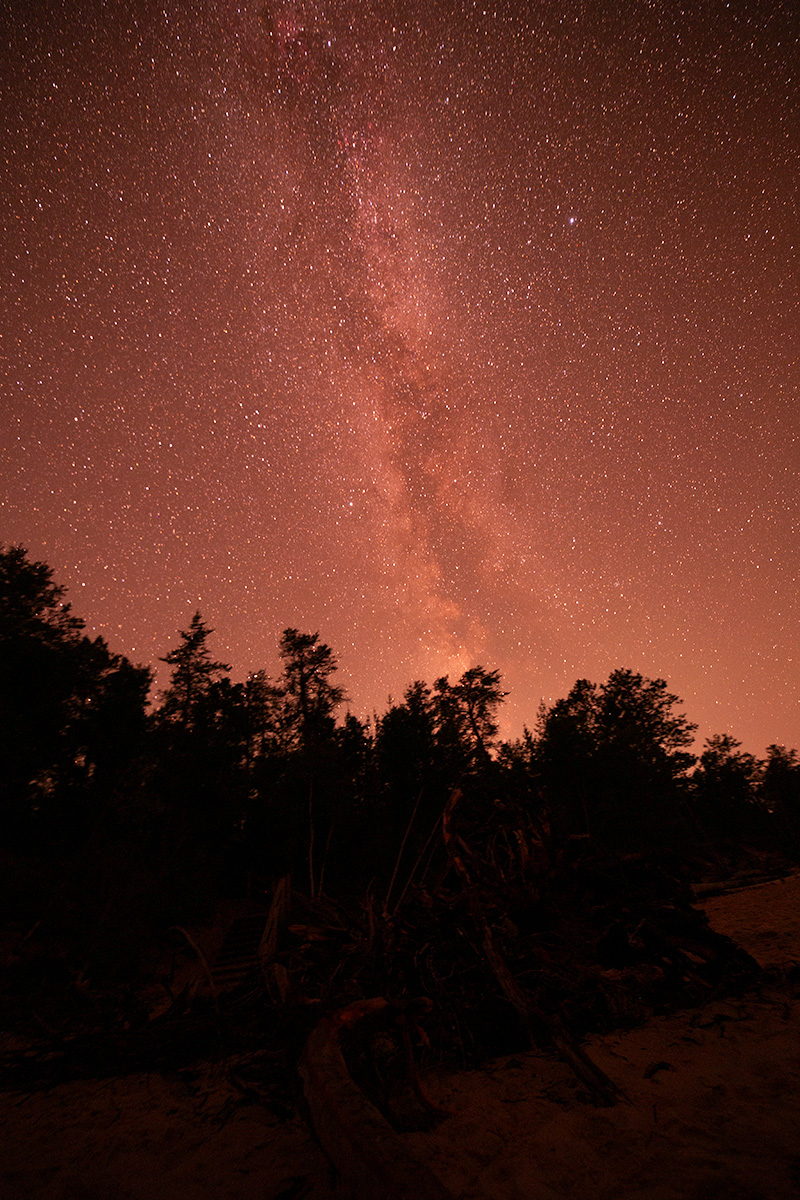
In the spirit of learning I uploaded an image I took in 2021. I included the unedited version so you can see what the Alpha filter does to the image out of the camera. This is an interesting shot for many reasons; however, it is full of technical problems. First this was a single image shot with my Canon 6D astro modified camera. The camera has a visible + H-Alpha filter installed and a heat reduction system to help keep the camera cool for extended exposures. The first thing I have to do is correct for the red the alpha filter brings out. This image was shot at ISO 3200, f 2.8 14 mm Rokinon lens for 61 seconds. I did not use my star tracker and you can see there is some slight star trailing. the foreground is very noisy. Because of the longer exposure my trees are blurry due to the wind and movement of the trees. It's difficult to get the entire image in focus with one shot and a shallow depth of field. The editing is horrible but you can see there is some very nice air glow in this image. My astro photography has evolved over the years and I am able to shoot and edit a much nicer image. I may re-edit this at some point in time. If there is an interest I can focus some of my next month's images on my astro photography and explain what I did with each image.
Posted: 10/10/2026 23:16:23
Cindy Bilinsky
It looks like it only let me load one image. Here is the edited image
Posted: 10/10/2026 23:17:38
Ruth Sprain
Wow! That's amazing to see the difference between your original photo with the Alpha Filter and your edited version. It sounds like you have an astro modified camera as well as the Alpha filter. Is this correct? Can the rest of us use a regular camera to shoot astro photos without a special filter? Posted: 10/11/2026 19:20:15
Cindy Bilinsky
Hi Ruth,
I will try to explain this better. My Canon 6D was modified to an astro camera and the alpha filter is installed in the camera along with a cooling system.
My Tahquanemon Falls image was taken with my Canon R5 and that is not astro modified. So yes you can take night images with a non-modified camera. I have taken astro images with my DSLR. mirrorless and iphone.
The astro modified camera helps to bring the reds out in many of the night sky nebula. The sky tracker helps with doing longer exposures and therefore there is more data and more detail to bring out in post processing.
I think this has spurred so interest in astro photography. I will try and post some of my astro work in the coming months and explain what I have done. There are so many things that can be captured in the night sky. Posted: 10/11/2026 21:20:08
Robert Coleman
Cindy, thanks for explaining how you took and processed the images. I admire your dedication to do the work in post on your astrophotography images. I look forward to seeing more of your work. Posted: 10/11/2026 22:00:04
Mary Ann Carrasco
Cindy, I have never used a star tracker...your stars/milky way are very sharp. And, the waterfall is beautiful with the slow shutter speed to smooth the water. There are as many preferences for night photography as there are people! For me, I prefer the foreground to be darker. In your image, my eye goes directly to the white of the waterfall. I noticed that looking directly into the image to the tree in the center, it looks like stars are in front of the tree. I see you mentioned what happened there in an earlier comment. I have much to learn re astrophotography and have only done it a very few times so your comments above are very informative and helpful. This image is beautiful and feels very "fine art" to me...like a painting! Posted: 10/15/2026 23:32:11